

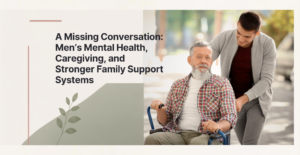
Families function best when every caregiver — fathers, mothers, brothers, sisters, sons, daughters, husbands, wives, partners, co-parents, grandparents, and friends — is informed, supported, and empowered.
Outside of Father’s Day and Men’s Mental Health Month, how can healthcare better support men not only as patients, but as caregivers?
At StoryCatch Partners, we believe caregiving is an essential part of healthcare. Every caregiver brings observations, experience, and strengths that can improve outcomes. That includes men who may quietly shoulder caregiving responsibilities while also navigating their own stress, grief, identity questions, or mental health challenges.
This is not about putting men and women into fixed categories. Caregiving is human. But expectations around gender, work, providing, strength, and emotional expression can shape how people ask for help — or whether they ask at all.
A More Nuanced Understanding of Men’s Mental Health
Over the past two decades, the conversation about men’s mental health has become more nuanced. It has moved beyond the simple idea that men do not experience emotional distress, or that they simply avoid help.
Men and women often experience many of the same life stressors: illness, caregiving responsibilities, financial pressure, relationship changes, trauma, parenting, divorce, aging parents, and loss. But the way those stressors are experienced, expressed, and addressed can differ.
Among many men, several patterns can emerge:
- Pressure tied to achievement, work, and identity;
- Stress associated with being a provider or protector;
- Isolation or self-reliance as default coping strategies;
- Substance use or overwork before seeking support;
- Mental health challenges following injury, illness, or physical trauma;
- Distress when they feel they are not meeting expectations that may never have been clearly discussed.
That last point matters.
Many men are not only asking, “How do I feel?” They may also be asking, “Am I failing?”
Failing as providers.
Failing as fathers.
Failing as sons.
Failing as husbands.
Failing as partners or co-parents.
When support systems miss that frame, they may miss the person.
Caregiving Is a Mental Health Issue
As families become more complex, more men are stepping into visible and invisible caregiving roles. They are caring for aging parents, spouses, children with complex needs, siblings, friends, and co-parents. Many are doing this while working full-time, managing financial responsibility, and supporting multiple generations.
Yet caregiving is still too often treated as something that happens outside healthcare rather than as part of healthcare itself.
Caregivers and family members are often the first to notice subtle behavioral changes, medication side effects, cognitive decline, emotional distress, changes in functioning, or increasing strain long before those observations reach a clinical setting. Too often, there is no clear pathway for those insights to be shared, understood, or used to improve care.
At the same time, caregiving changes the caregiver.
A man who is struggling may not say, “I’m overwhelmed.” He may throw himself into work, focus only on solving practical problems, become increasingly isolated, seek relief through alcohol or other substances, or experience strain in important relationships.
Recognizing these signs earlier — and supporting caregivers before they reach a crisis — should be part of whole-family care.
Co-Parents, Partners, and the Family System
One place this matters deeply is co-parenting.
When a child, teen, or young adult is struggling, the caregiving system around them often becomes strained. Parents and co-parents may respond differently. One may move toward emotional processing, while another moves toward action. One may want to talk; another may want a plan. One may appear detached when they are actually frightened. One may appear controlling when they are trying to protect the family from further harm.
These differences can create conflict. They can also become strengths if families are given language, structure, and support.
The goal is not to make every caregiver engage in the same way. The goal is to help each caregiver become more effective, more connected, and less alone.
What We’ve Heard from Men
Through conversations with caregivers, men’s groups, parents, and families over the years, one theme has repeatedly surfaced:
Many men were not asking permission to care. They were asking whether they were doing it right.
Some men worried they had not been emotionally available enough. Some worried they had been too focused on work. Some wanted to parent differently than they had been parented. Some were trying to become better partners or co-parents without having many models for what that should look like.
The most effective support did not simply tell men to “open up.” It helped them reframe what strength can look like.
Strength can mean asking for help before reaching a breaking point.
Strength can mean communicating expectations with a partner or co-parent.
Strength can mean listening when problem-solving is not what a loved one needs.
Strength can mean staying connected when the old script says to withdraw.
For many caregivers, reframing “providing” can be a relief.
Caregiving is not a distraction from success. It is part of success.
Why Peer Support Matters
Isolation is one of the most dangerous parts of caregiving. Community is one of the most protective.
People benefit from spaces where they can exchange practical advice, learn from others with shared experience, and discover they are not the only ones carrying a particular fear, question, or responsibility.
Sometimes what helps most is not another resource. It is another person saying, “I’ve been there.”
Peer-led and peer-informed support can be especially powerful because it meets people closer to where they are. It can combine practical problem-solving with trust, perspective, and emotional permission. For many men, that combination may feel more accessible than a traditional mental health entry point alone.
Where Healthcare Can Go Next
If we want to improve family health, we need to intentionally include caregivers.
That means recognizing caregivers as part of the care ecosystem, not passive observers. It means designing support that reflects how different people engage. It means valuing practical action and emotional connection. It means learning systematically from lived experience so that future families receive better support than previous generations.
At StoryCatch Partners, we believe those lived experiences are more than personal stories. They are valuable signals. They help us understand what families need, identify gaps in care, and design better systems for the future.
Supporting men’s mental health is not only about helping men.
It is about strengthening the families, partners, co-parents, children, parents, and communities who depend on them.
A family-centered future requires every caregiver to be seen, supported, and included.